Showing posts with label self-sufficiency. Show all posts

Sunday, November 18, 2018

A Life Well Lived

One winter, the peasant woman from up the road decided to help me out. We were living in an 250 year-old stone house with our four small children. We were very happy: it was a life well lived. But my husband and I were sleeping on old foam mattresses on antique metal bed frames.

Fleeces

Angelina suggested that she and I spend our winter evenings making a mattress.  My husband could build a frame in the springtime, and then we would have a new bed. We got to work. First, she obtained five sheep fleeces from who-knows-where. Then, we arranged them on the ground in front of our house, and we washed them with the outside tap I usually used for washing my chickens. More about chickens later. We put the fleeces on the ground fleece side up and we shampooed them to get them as clean as possible. Then we hung them to dry. When they were good and dry, we got to work


A very fine house

Our house was huge. The animals used to live on the ground floor, but we didn't keep large mammals. This floor would become a beautiful farm kitchen, with a fireplace at one end, two large French doors looking out onto our land, and a wood stove that I cooked on. There were iron rings attached to the stone walls, and a large cantina in the back of the house which was cool enough to store wine, fruits and vegetables.

For the first few years, though, we lived on the second floor, which had a large kitchen, with a fireplace, and two small bedrooms on each side. One bedroom was for me and my husband and the baby. The other one was for the three other children until the baby was big enough to move in. Then the four boys slept together in the tiny ramshackle room. The third floor was beautiful and spacious. The roof leaked though, so we didn't go up there until a few years later when my parents moved in for a few months of the year.


Teasing the fleece

Every evening Angelina would walk down from her house, with her cane and her flashlight. We would drag the fleeces out from where we stashed them during the day, and she and I would sit and chatter while we teased the wool from the fleece.

A fleece is the wooly "hair" of the sheep that is sheared from the live animal. It is not a dead skin like, for example, the hide of a cow. It is often very, very dirty, because the sheep has probably lived a life dragging their coat through brambles, other plants, mud, and everything that nature provides for animals to live in. We wanted to get that wooly fleece as clean as possible, so we took the wool, handful by handful, and "teased" out the seeds, pieces of mud, plant debris, and the who-knows-what, night after night, for months. We put the cleaned fleece in to pillow cases and I stored them until they were needed.


Peasant life

What did we talk about? Angelina told me stories about her life. She was old. She'd lived through the war, and a bad husband. She taught me about peasant life: how to cook, take care of animals, plant and care for a garden, a fruit tree, a vineyard. She was uneducated, a little ignorant. But she had a big heart and she was happy that I was happy to learn from her. I would tell Angelina about my life: my family, Canada, city life. But I don't think she really cared.

We would start when the children were still awake and she would continue teasing the wool while I put them to bed. Then we would go on a little longer and she would leave, walking back up the hill to her house. Every evening, I would be left with my pillowcase of cleaned wool, the dirty fleece that I would hide away, and a pile of debris to sweep up and throw  onto the compost.

One fine evening we were finished. After a few days, Angelina showed up with a gigantic pillow case made of striped ticking. That evening, we started stuffing the mattress. The children were very excited. We stuffed all of the cleaned fleece into the mattress bag: then came the hard part. Fleece was everywhere. We had to close the bag and make sure the fleece was equally distributed throughout the mattress.


Making the mattress

Angelina had a huge needle and thick thread, and she sewed the top together tightly with big stitches, then we made nicer-looking seams with smaller needles and thread. She threaded the big needle with thick cotton thread and we pulled the thick thread right through the mattress, at even intervals about six inches apart all through the mattress, from top to bottom and side to side. We tied tight knots in the cotton thread on each side, and these kept the wool inside the mattress even and firm.

Our mattress was ready! My husband built us a huge bed out of chestnut wood, and the work was done. The bed is still as solid as ever, but last week we finally got rid of the mattress, after 25 years. It smelled funny, and it was a little lumpy.

A life well lived

Those years on the farm created a foundation for my life and the lives of my children that on the one hand has given me the sanity and the strength to try to live well. On the other hand, I had an insight into a life well lived, by which I mean a life that is connected to our material reality, and so when I contrast that with the life I witness here, in the city, on the social media, in peoples' appetites and dreams and lived lives, I am profoundly disappointed and confused.

"Things fall apart; the centre cannot hold" (Yeats, The Second Coming).

No, I am not talking nostalgically about going back to the middle ages, when disease and superstition were rampant, and infant mortality made mothers immune to sadness. But I am definitely talking about returning to a human centre for our lives; a human centre that is connected to the material world in a way that is not a fleeting commercial exchange, or a limp handshake. Instead, I am talking about a connection that helps us to take the good, the bad and the ugly of this world and live fully conscious of our choices and actions. That connection can only come with a return to the physical in our lives: cooking food, walking, fixing things, sewing, knitting, mending, gardening, making things.


The birth world

I worked in the maternity care field for about twenty years of my life. Now, there's an interesting place to start looking at how our culture has on the one hand made tremendous advances that should be celebrated, and on the other hand has created a culture of fear that has had truly paralyzing effects. We have reduced infant mortality by leaps and bounds, just over the past couple of centuries. Science has given us the opportunity for transformative care for women and babies. We can cure heart defects whilst the baby is still inside the womb, and we can prevent life-threatening diseases during pregnancy, and save mothers and babies with quick and effective surgery and drugs. These are wonderful advances.


Fear and loathing

We've also become afraid of living life to the extent that we've been giving drugs to women and their unborn children that may not be the best for them, for us and for our future. What are the real effects of synthetic oxytocin on the unborn child, and on the mother? No one knows. What are the links between a 90 percent epidural rate for first time mothers (one drug in the epidural cocktail is often Fentanyl), and the modern Fentanyl addiction epidemic? No one knows. Some people choose to jump outside the whole system. Is this a good idea? Again, no one knows.

We are chasing our tail; we're afraid; we are separated from our basic, physical existence. Our society has created children so terrified to be themselves that they need expensive drugs (that also have not been thoroughly tested), and surgeries (ditto) to re-create an image of themselves that they can feel comfortable with.


Scary mama

Every month or so I would put a certain red woollen hat on, tuck my pants into my boots, and cut six strings of the same length. I would make sure the youngest was happily watching his favourite movie, sharpen my knife, and head down to the chicken coop. The birds would know. It was a little later than usual to open up; I was wearing my red hat, and instead of opening the door I would come inside the coop. My ladies would chitter-chatter amongst themselves. I picked the six oldest, or the bad-tempered ones, or the ones who weren't laying enough. I would grab them by the feet, tie them up, and take them outside. Oh, before I tied them I would give them a little vag exam. If there was an egg coming down the chute I would let them go.

Once outside, the door was left open so the other birds would come out and strut around, happy they were not tied up. The six selected for dinner over the next few weeks would be strung up on a post and killed. I killed them humanely, cutting their jugulars quickly and effectively. Then I would pluck them, clean them and freeze them. On those days the kids would come home from school and have fried gizzards, hearts and livers for lunch. Yum!!!

My kids grew up knowing that if you choose to eat meat, it comes from a live animal that you have to kill. They saw me being as gentle as anyone could possibly be if someone had a boo-boo or a small chick was being hatched. But they knew I could also be Scary Mama (okay, fucking terrifying mama) and take away the life of a living creature, if I wanted to serve it for dinner.


Chop that wood. Carry water.

And, yes, I went down to the spring every day and hauled back my 20 litre container of water. Drinking water was good from the spring; our tap water came from the pond which was gross. We heated our house with wood: a fireplace and two wood stoves. Yes, we had electricity. I had a washing machine.

We made our own bread, provided food from our land, drank wine from our vineyard. We were terribly poor. The kids didn't have opportunities so we came back to modern life to provide them with more. Was it worth it? Yes, a million times yes. Our lives have been enriched in so many ways by the experience of living a life on the land. Our relationship to each other, to the outside world, to food, to the houses we live in, to travel, is rooted in our unusual time together on "the farm".


A good idea

None of our kids has chosen rural poverty as an attractive option, as we did when we were in our twenties. But all of them know how to cook, and all of them could kill a chicken if they had to. They could all stay alive in a forest if they got lost, identify what herb could stop a nosebleed (yarrow: stick it up the nostril), or know what mushroom can kill you. And I believe that this type of knowledge is fundamentally connected to the ability to be tolerant. Not tolerant in a flimsy kind of liberal limp-handshaky way. Tolerant in a way that comes from a sense of "well, the world is such a bizarre, messed up, beautiful, paradoxical, contradictory, overwhelming place" that I might as well agree to disagree with that asshole. Even if he clearly doesn't agree with a word I have to say.

I have a good idea: bake a loaf of bread and invite someone you really don't agree with to come and eat it with you. Or better yet, make a whole damn meal, four or five courses, and invite a bunch of people you are sure will upset you, just to sit at your table, eat, and share the oxytocin.

tribute to Anthony Bourdain June 25, 1956 – June 8, 2018

"It seems that the more places I see and experience, the bigger I realize the world to be. The more I become aware of, the more I realize how relatively little I know of it, how many places I have still to go, how much more there is to learn. Maybe that's enlightenment enough - to know that there is no final resting place of the mind, no moment of smug clarity. Perhaps wisdom, at least for me, means realizing how small I am, and unwise, and how far I have yet to go."

Sunday, November 19, 2017

How to Build a Wood Oven from Scratch: Part One of Three

I love pizza! And lasagna! And freshly baked foccaccia, any other kind of bread ... did I mention paper-wrapped fish? I guess you might call me a foodie. I own a cafe, and I can cook a mean meal in no time at all (right now my cooking muse is Kenny Loggins, but that's another story ... ).

But the best? The best is cooking either over a fire ... or in a wood burning pizza oven.


So, seeing how we always just get sh** done, my husband and I decided to build one a couple of summers ago. It took two summers altogether because we poured the cement platform at the end of one summer then built the oven last year. It was fun, challenging at times, and we certainly had some "duh" moments.

Here's a visual guide to building your own wood oven. I will describe exactly what we did, how we did it, what we used, and lessons learned!

Part One explains how to build the cement platform, and lets you know what you will need for this building adventure.
Part Two describes how to build the brick stand for the oven, and
Part Three guides you through the complex task of making your oven dome.

Part One of How to Build a Wood-Burning Pizza Oven from Scratch

What do I need to build my own wood oven? 

First, you will need a flat area outside where you will have enough space to store wood, move around while you're cooking, and where you will not be smoked out when the fire is lit.

Materials:
Tools

Measuring Tape
Square
Straightedge
Hammer and Nails
Building lumber
Spirit Level
Builder's String
Hoe
Rebar Mesh (two times the size of the cement platform)
Building lumber
Sand
Cement
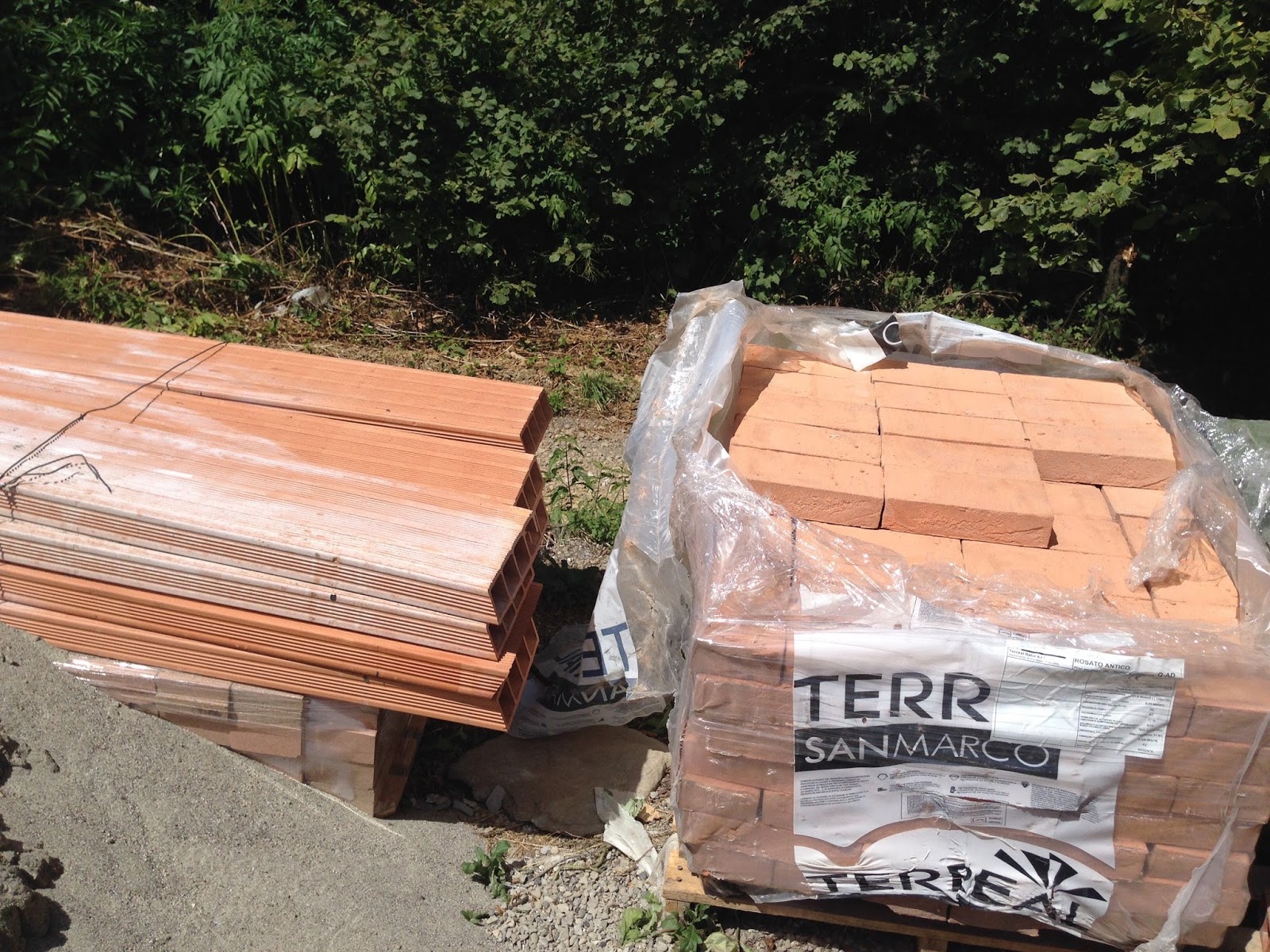
Building Bricks - at least 200 regular size and 40 flat slabs

Bricks for Wood Oven


Fire Bricks
Fire Bricks - regular bricks (at least 100) and flat bricks (around 40)
Hollow clay slabs -  enough to cover the stand: the first layer of the support for the oven.

We built our oven in Italy, you you will have to look at the measurements of the bricks in your  country and calculate accordingly.

What to do?

First, who is building this thing? Whoever is building it or will use it should sit together, then wander about a bit, maybe with a beer or other cold drink in hand, and figure out where you want it. This is very important! You will be cooking food here, so it should be close to a kitchen or so.
Also, it's going to be smoking sometimes, so you want to position it somewhere the smoke won't be floating straight into someone's bedroom or whatever.

Okay, you've decided where you want it, now you have to build a flat cement platform that your beautiful wood burning pizza oven will rest on.

How big should the platform be?

We decided that we wanted an oven with an inside diameter of one meter. So, calculating from that, our stand needed to be about 1.5 by 2 meters. and the cement platform obviously bigger than that.

The nitty-gritty of making a cement platform:

Block out your area. You will need builder's string, your metal square, and some wooden stakes. You need a flat area!! If you're working on a slope, your construction will need to be levelled. It's possible - we built ours on a piece of land that is terraced and on a very steep hill. But it takes a lot more work, and you have to get to work with a shovel and hoe and make sure the whole area is flat (use a board with a spirit level on it if you don't have a long enough spirit level).

Measuring for the platform

Using the Square

String Guides for Frame

Good Job!

Flattening area
Build your Frame. When you've found or created your flat area, decide how big you want it (see above). You need to make a perfect rectangle. Hammer two stakes into the ground, the distance of the width of the rectangle. Tie your builder's string from one stake to the other. Place the square along the edge of the string, to make a 90 degree angle, and stretch string from that stake the length of the rectangle. Hammer your third post in, then use the same method with the fourth post. Check that all the angles are 90 degrees, and adjust accordingly.

Building Supervisor
Now you have your area, and you need to sit back and have a drink (water ... or a nice cold beer). Are you really, really sure this is where you want to build your oven? Yes? Ok, let's move on.

You're going to be pouring a four-inch foundation on to this rectangle. You want to make a frame that you'll be pouring the cement into. Find your boards (1 by 4 planks), two width length and two the length of the rectangle. Hammer the planks to the INSIDE of the stakes, and check again if everything is at right angles. Just for the sake of caution, you can hammer a stake in the middle of each longer board to prevent bulging. If the boards are 4 inches wide, the height of the frame will be a tiny bit smaller. Doesn't matter. You will be pouring to the top of the boards.

First side of rectangle

First corner


Completed frame
Put down your rebar mesh. Now you need to put down your rebar mesh. You want 4 mm rebar, and it will come in an area bigger than what you'll need. So you'll need to cut it to size. Measure very carefully - obviously its better a tiny bit smaller than too big for your frame. You can cut the rebar with a grinder or with rebar shears (rent them!). When it's ready (take another drink - water this time!), you want to place it in the frame, but you don't want it to be right on the ground, so you'll want to raise it a little (a couple of inches or about 4 cm). Place four broken bricks or flat stones around the rectangle inside the frame, and then lower your rebar mesh onto the stones, inside the frame.

Rebar mesh laid inside frame

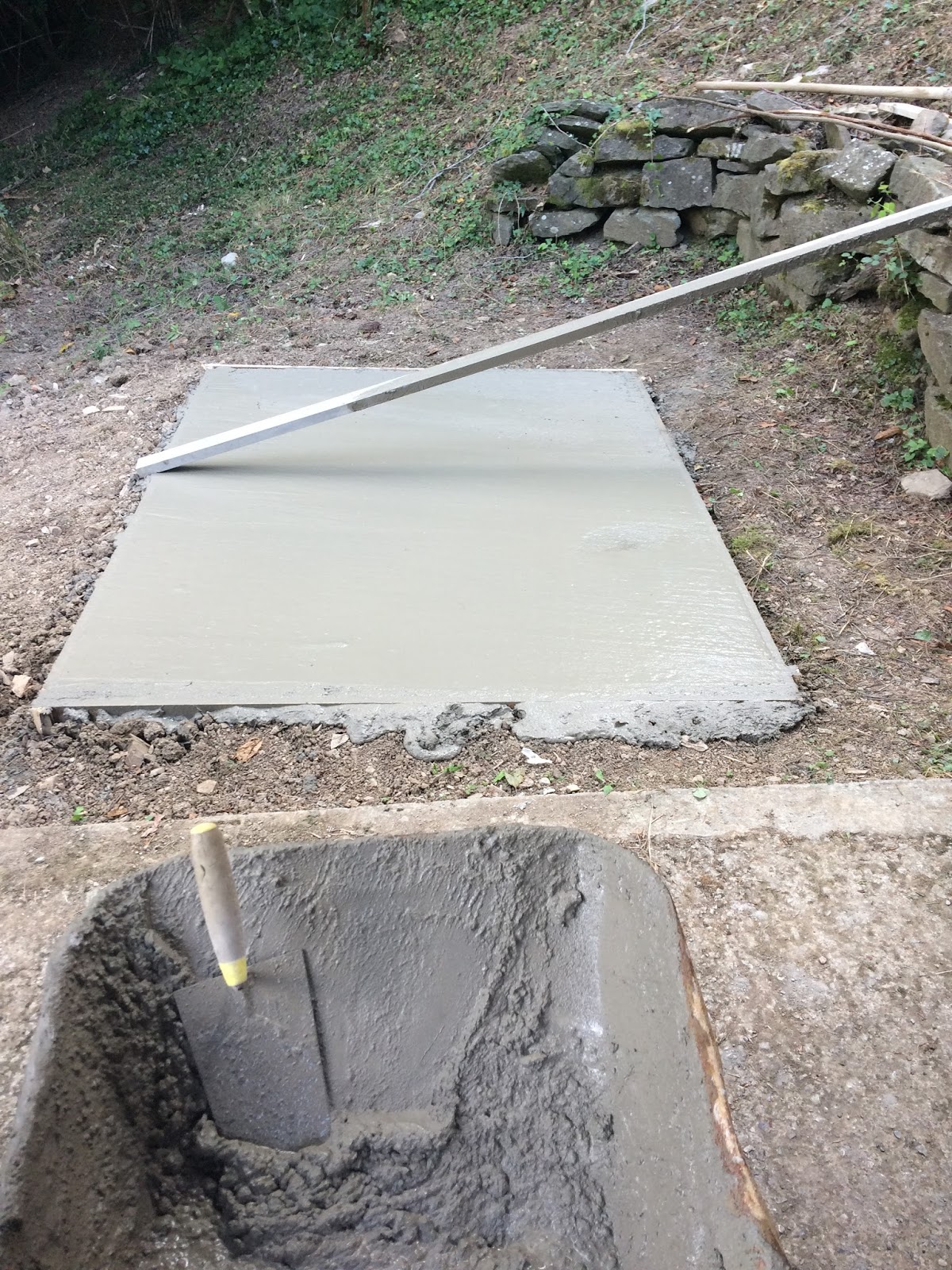
Pour the cement!
Now you're ready to pour! If you're a seasoned cement user, and you have a cement mixer, mix your cement to a foundation-ready consistency.
Wheelbarrow full of cement
Otherwise, buy your concrete mix (a mixture of sand and cement that you just have to add water and mix - you can mix it in a wheelbarrow) - and start pouring! As you pour, you need to flatten the cement with your straightedge and make sure it is nice and flat with no little holes, bubbles or random twigs. As you can see from this picture, the amount of ready-mix you need goes by area:
and remember it's always better to have a little too much cement than too little! You can always find a small hole that needs a little cementing or just throw it in the neighbour's trash (kidding) but if you have too little, you need to make a cement run which is a hassle.

Cement Ready

Pouring Cement

Building Mama
Like I said, we built our wood oven on land that is terraced, so we had to mix the cement in our mixer up top and then pour it down our home-built cement sluice to the lower terrace.You don't have to do this!!!

When your cement is poured, you need to make sure it's nice and flat. 
First pour

Flatten cement


Finished Platform!!

Sit back and look proudly at your work. Let it dry for a few hours until it's hard, then water it twice a day for the next couple of days. Yes, water it. Pretend it's a lawn and sprinkle it well with water. This will prevent cracking. You can't go to the next step for at least 12 hours! Leave your boards on overnight so the cement will dry straight.

In the meantime, sit back and relax, and get ready for tomorrow, when you're going to build your brick stand.


Stay tuned for Step Two: How to build a sturdy brick stand for your wood-burning pizza oven.

Wednesday, July 20, 2016

T is for Tea, and so grateful for a cuppa tea.

T is for Tea, of course. And just as a conversation meanders around a pot of tea shared among friends, so this conversation slowly and circuitously will get to the points.

My mother worked teaching mathematics and then she went to art school, but I always remember her being around in the evenings, ironing, listening to the radio, and whenever I got home in whatever state I was in, she would offer me a nice cup of tea. That meant strong, very strong, hot, with milk and usually sugar. Maybe a piece of dark chocolate along with it that you could dunk. 

Anything could be solved with a cup of tea! Or at least, you would feel better if you drank a cup of tea while dealing with your stuff.

I never realized until she died that it was really and truly possible to love someone and pretty much hate them at the same time. Or, that love didn’t necessarily cure all the awful effects of betrayal and those kinds of things that can inhabit a marriage.

I learned from her that life is a long process of learning how to inhabit contradictions.

Back when I was a hipster, before hipsterdom had come into being, I had two outfits: a pair of army pants and a turquoise and black striped cotton skirt. I wore them with a green boy scouts shirt or a neon pink lycra polo. I had a good luck bird tattooed on my chest. I never gave anyone the time of day. I must have been a pain to get along with. I was tough. I tried everything but got stuck to nothing. I was barred from the Alcatraz for throwing a table. I hit an Egyptian man in the chest with a rock when he whispered fucking to me on the street in Cairo.

I inhabited a world where poetry reigned supreme, and justice was always possible, with enough struggle.

I traveled through Africa alone because that’s where I was born.

I got a degree in ten years, because there was always more interesting stuff to do.

I had babies, lived on a self-sufficient organic farm, learned to be a midwife, joined and left a religious cult, kept a marriage going, started running, cooked food for myself and others, left continents and returned, learned and forgot languages, and through it all I have never inhabited the high ground to your low ground. And I refuse to inhabit the low ground to your highs.

There is no high ground. When you imagine that the ground you inhabit is higher than others, you start to sink and that sinkhole, although attractive, is ultimately another illusion. One time we were sitting having tea on our farm, amongst the mess and chaos of small children and a subsistence farm ... and my mother's cup lost it! The cup of tea just dropped in to her lap and she was left holding only the handle. Wipe up, crack up, use the handle-less cup for a paintbrush holder, and get on with it, in true Cockney fashion.

So here’s a cup of tea to you, and here’s to having a cup of tea with each other, and here’s to all the things that may or may not begin with the letter “t”, and here’s to living deeply: deeply within and surrounded by contradiction and paradox. Here’s to continuing to have friendships and relationships with people who don’t necessarily see eye to eye with me, who don’t agree with me, who don’t understand where I am coming from. Here’s to long nights of discussion and here’s to building a strong house of thought using the bricks and mortar of our own imaginations. Here’s to open hearts and open minds, to loving and hating, to sadness and intense joy, to night and to day.